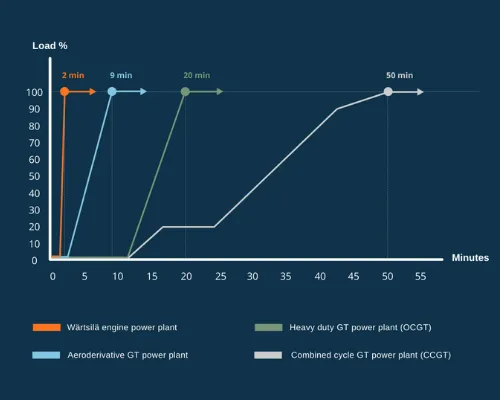
The discussion below describes the current perceived front runner solution for the last stage decarbonisation of many grids which do not have huge hydro resources. It assumes no dramatic improvements in the economics of existing LDES (long duration energy storage) technologies. In the subsequent detail sections some of these assumptions are explored in more detail to present possible alternative solutions.
In the future, wind and solar generation are expected to dominate electricity supply in the majority of grids, with other forms of generation providing a much lower fraction of supply. However, wind and solar are variable and weather dependent, leading to periods of gaps in supply, split here into short duration gaps of less than a day and long duration gaps of a day up to a month or more.
Thus, affordable overgeneration (relative to total grid demand TWh per year) from wind and solar of 20-30%, will lead to periods with gaps in supply of, perhaps, 10-20% of grid demand, plus periods of surplus power.
Up to 8 hours of average load of grid battery storage is required to fill short duration gaps in wind and solar generation, depending on the proportion of flexible demand within total grid load. Some demand is flexible in when it must be met, and does not required battery smoothing to fill short duration gaps. This includes:-
- the majority of EV charging, such as a BEV with a 300 mile range and a 30 mile daily round trip commute has up to 7 days of flexibility in when to charge before the battery charge drops below 30%.
- heat pumps with one or two days of phase change thermal storage (likely 1 to 2 cubic meters of phase change storage), clearly have up to 24 hours of flexibility in when to charge.
- electric pool heaters
- domestic appliances, such as fridges, freezers, washing machine, dish washers and tumble dryers, where the precise timing of operation is not critical.
The reason these loads can be supplied flexibly is that they incorporate their own forms of storage. In the case of EVs the storage is the EV battery itself. For heat pumps it is the phase change thermal store – which could be equally applicable for air conditioning systems.
Operating as flexible demand response loads, these devices can smooth some imbalances between grid demand and supply.
Note: although these particular flexible loads do not require short duration grid battery storage, their supply cannot necessarily be postponed indefinitely. In the case of a long duration gap in wind and solar, these demands must be satisfied from natural gas backup plants (in a pre-net zero grid) or long duration storage (typically green hydrogen storage and hydrogen fired CCGT or OCGT plants in a net zero grid).
The aim should be to provide sufficient short duration storage (/demand flexibility) to reduce the requirement for invoking long duration backup to less than 10% of supply.
Many mature grids have sufficient natural gas turbine generation to meet demand in the absence of adequate output from wind and solar generation. Once sufficient grid battery storage is installed to smooth over the short duration gaps, these natural gas turbine plants will be retained as backup plants to fill long duration gaps in wind and solar output, of a day up to a few weeks.
Thus, many grids may be able to reach 90% decarbonisation while continuing to use natural gas as a backup fuel.
To meet a grid net zero CO2 emissions target, the backup fuel must be switched from natural gas, to green hydrogen. The green hydrogen can be produced via electrolysis of water using surplus wind and solar power and stored underground in man-made salt caverns or depleted oil and gas wells.
CCGT (combined cycle gas turbine) or OCGT (open cycle gas turbine) natural gas generation plants can be converted to use green hydrogen by changing the burners and some other components. Safety systems must also be upgraded. Many recent gas turbines are designed to make the change from natural gas to hydrogen fuel more straightforward. For instance, some GE gas turbines can already take a fuel mix from 100% methane (natural gas) up to 100% hydrogen.
Some flexible loads may not require backup (or may require only partial backup) for long duration gaps. These include:-
- electric arc furnaces, to make steel from recycled scrap steel, can be switched off completely at the end of a batch. Since electricity is a significant proportion of costs, such furnaces can be operated only at times when no backup is required, and power is thus cheap. There is flexibility in when to start processing a batch of steel, but not that much flexibility once it has been started.
- aluminium smelting involving electrolysis of bauxite (aluminium oxide) can be ramped up or down, depending on the cost of electricity. Trimet has designed plants which can be ramped up or down by 30%. 70% operation aims to keep the cells hot enough to prevent the contents from solidifying. Although backup is needed for such 70% operation, this does reduce the required provision of backup capacity relative to the average load for the operation. The Trimet plants can also respond within milliseconds to a change in the grid balance between supply and demand.
In such processes, the stock of finished material produced substitutes for the some or all of the backup or long-duration storage required to ensure the necessary degree of reliability of supply applicable for this particular process.